

PDF kostenlos Thus Spoke Zarathustra: A Book for Everyone and No One (Penguin Classics), by Friedrich Nietzsche
PDF kostenlos Thus Spoke Zarathustra: A Book for Everyone and No One (Penguin Classics), by Friedrich Nietzsche
Wenn Sie bei den Zuschauern, die ständig überprüft, um viele Bücher sowie zu konkurrieren komplett andere, ändern Sie Ihre Gedanken jetzt etabliert beginnen. Lesen ist nicht Art des Wettbewerbs. Die Methode, wie Sie bekommen genau das, was man aus dem Buch 1 Tag über genau das bestätigt bekommen, was Sie aus der Lektüre tatsächlich bekamen. Für Sie, die sehr viel nicht gefällt auszuchecken, warum Sie nicht versuchen, mit dem Thus Spoke Zarathustra: A Book For Everyone And No One (Penguin Classics), By Friedrich Nietzsche Diese Veröffentlichung vorgesehen auszuüben ist, was sicherlich Sie Ihre Meinung verwandeln machen.
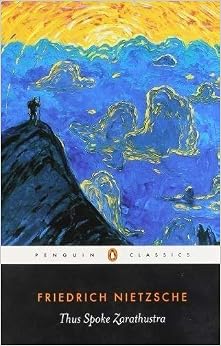
Thus Spoke Zarathustra: A Book for Everyone and No One (Penguin Classics), by Friedrich Nietzsche

PDF kostenlos Thus Spoke Zarathustra: A Book for Everyone and No One (Penguin Classics), by Friedrich Nietzsche
Testen des Gehirns zu glauben, besser und schneller kann durch einige Verfahren durchlaufen werden. Erleben, die andere Erfahrung zu hören, auf Abenteuer, Studium, Ausbildung und zusätzliche praktische Aktivitäten helfen können Sie zu verbessern. Aber unten, wenn Sie die wichtigen Dinge gerade nicht genügend Zeit haben, können Sie eine wirklich einfache Art und Weise nehmen. Lesen ist die einfachste Aktivität, die alle über Sie wollen getan werden kann.
By checking out Thus Spoke Zarathustra: A Book For Everyone And No One (Penguin Classics), By Friedrich Nietzsche, you can know the understanding as well as points more, not only concerning exactly what you receive from individuals to people. Book Thus Spoke Zarathustra: A Book For Everyone And No One (Penguin Classics), By Friedrich Nietzsche will be much more relied on. As this Thus Spoke Zarathustra: A Book For Everyone And No One (Penguin Classics), By Friedrich Nietzsche, it will truly offer you the great idea to be successful. It is not only for you to be success in particular life; you can be effective in everything. The success can be begun by understanding the fundamental understanding and also do activities.
From the mix of understanding as well as actions, an individual could boost their skill and capacity. It will lead them to live and work much better. This is why, the students, employees, and even employers need to have reading behavior for publications. Any type of publication Thus Spoke Zarathustra: A Book For Everyone And No One (Penguin Classics), By Friedrich Nietzsche will certainly provide specific expertise to take all perks. This is just what this Thus Spoke Zarathustra: A Book For Everyone And No One (Penguin Classics), By Friedrich Nietzsche informs you. It will certainly include more expertise of you to life and work far better. Thus Spoke Zarathustra: A Book For Everyone And No One (Penguin Classics), By Friedrich Nietzsche, Try it as well as verify it.
Based upon some experiences of lots of people, it is in truth that reading this Thus Spoke Zarathustra: A Book For Everyone And No One (Penguin Classics), By Friedrich Nietzsche could help them making better option and give more encounter. If you wish to be among them, allow's acquisition this publication Thus Spoke Zarathustra: A Book For Everyone And No One (Penguin Classics), By Friedrich Nietzsche by downloading guide on web link download in this website. You could obtain the soft file of this book Thus Spoke Zarathustra: A Book For Everyone And No One (Penguin Classics), By Friedrich Nietzsche to download as well as put aside in your readily available digital devices. What are you waiting for? Allow get this publication Thus Spoke Zarathustra: A Book For Everyone And No One (Penguin Classics), By Friedrich Nietzsche online and also review them in at any time as well as any sort of area you will check out. It will certainly not encumber you to bring heavy book Thus Spoke Zarathustra: A Book For Everyone And No One (Penguin Classics), By Friedrich Nietzsche inside of your bag.
Synopsis
No modern philosopher has been more completely misquoted and misrepresented than Friedrich Nietzsche (1844-1900). His phrase, "God is dead", his insistence that the meaning of life is to be found in purely human terms, and his doctrine of the superman and the will to power were all later seized upon and unrecognizably twisted by, among others, Nazi intellectuals. This translation of "Thus spoke Zarathustra" a spiritual odyssey through the modern world, enables the reader to judge for themselves an original thinker who has had a powerful influence upon such 20th century writers as Shaw, Mann, Sartre and Camus.
Über den Autor und weitere Mitwirkende
Frederich Nietzsche (1844-1900) became the chair of classical philology at Basel University at the age of 24 until his bad health forced him to retire in 1879. He divorced himself from society until his final collapse in 1899 when he became insane. He died in 1900. R.J. Hollingdale translated 11 of Nietzsche's books and published 2 books about him.
Produktinformation
Taschenbuch: 352 Seiten
Verlag: Penguin Classics; Auflage: Reprint (28. Februar 1974)
Sprache: Englisch
ISBN-10: 0140441182
Größe und/oder Gewicht:
13 x 2,2 x 19,8 cm
Durchschnittliche Kundenbewertung:
3.9 von 5 Sternen
20 Kundenrezensionen
Amazon Bestseller-Rang:
Nr. 9.916 in Fremdsprachige Bücher (Siehe Top 100 in Fremdsprachige Bücher)
Late one night after I had read the last page of Nietzsche's Zarathustra, and before rereading the first page, I fell asleep and dreamt a dream of all that logically went between: When Zarathustra was over one hundred and ten years old, and it was the appropriate time, he died in an out of the way place called Bethsaida (The New Testament place where Jesus' preaching was ignored).The sun did not rise and the rooster did not crow, prompting his frightened neighbors to summon a doctor and an exorcist - this being customary in such circumstances.Although an examination revealed some peculiar marks visible on Zarathustra's head, neck, chest, and ankles, these were dismissed as some type of permanent political stigmata; thus the death certificate was signed.Word of strange events then spread quickly throughout the town, and to soothe the worry of more naive minds the ecclesiastical authorities decided to place Zarathustra in mock trial. Propped up in a chair and held fast by ropes, the old man offered no resistance to the arrangement. A Catholic volunteered as prosecutor, a Protestant as judge, townspeople of varying descriptions acted as jury, and a popular baker represented the accused. "Here is the demon who even now manages to provoke our anguish with his legacy of atheistic malevolence. Let him be found guilty, then forgotten forever in the unhallowed ground" railed the prosecutor. As for the baker, being a simple man outside the established ways of theological and legal argument, his only recourse was to draw upon his own experience while speaking for the accused: "It may be a difficult leap to make, fellow citizens, but even here is the image of one deserving your love. Zarathustra's intention was not to destroy you or even to take anything away from you - it was to make you stronger! It is better to liken even his most merciless prods to the yeast which causes bread to rise to its full height.""That's quite irreverent, though it may be material," countered the prosecutor; "for in my church, before the sacrament of Eucharist is distributed, we draw on stocks of unleavened bread." Certainly, this was a promising point, but as it was now long past the time desirable for everyone's noontide meal, and the baker had the means to relieve their greatest emptiness, he decided to provide a tasty riposte: "In all appreciation of that exception, as it is I who provides all the bread in this district - including what the churches distribute to the poor - it should be pointed out that the supply of flour available for my helpers to gather has been diminishing, and only the prudent use of yeast can insure enough to feed everyone" Needless to say, the verdict eventually came in that everyone involved was ravenously hungry, which did much to expedite a decision on Zarathustra: And that is how he came to be buried, in sort of a compromise, beneath an unhallowed path immediately outside the narrow gate of the cemetery. Yet, not long after, three scruffy looking grave-robbers arrived to fetch him from where he was content to lay; a Marxist, an anarchist, and a gaunt faced national socialist. And while these three engaged in an acrimonious debate about who was Zarathustra's nearest relative, they dug up his material body and carried it away. Yes, stiffened arms jutting over supporting shoulders, and ramrod legs held in trembling hands, they stumbled away like drunken sailors returning to the safety of some familiar ship.What little reason remained soon gave way to emotions, as the three were so overwhelmed by their old master's predicament that they were incapable of recognizing his true condition. "Zarathustra wants to come with me" blubbered the Marxist. "His persistent posture indicates he is only battered and still unbowed." To this the gaunt faced national socialist replied, while bearing the burden on the other side, "Your brain is out of dialectical order, halt-foot! The fox feigns his injury, and your only reward will be a bite of my old values." Then holding up the feet and walking backwards, the anarchist insisted - as usual- in getting in the last word: "Far from having any immediate ambitions, it's obvious my uncooperative brother is determined to impede you."Soon, all that was left at the open grave was a discarded shovel, the only lantern the three had brought to know the way, and the odd flickering shadow of Zarathustra's spirit. This ghost sat on a big stone nearby, closer than any of them had dared to hope, and it waited until the declamation of the last follower died out in the wintery night air: "O restless dark day! You herald the approach of a new dawn!" Said Zarathustra's spirit. Then finding a more definitive aphorism rising in his throat, he summoned his animals to draw near; for wise enough to keep a respectable distance from the fray, they had only waited to hear. And although at first they didn't recognize Zarathustra's now child like countenance - which usually moved much slower, the bad poetry reassured them: "Lost and marooned are they who nourish themselves solely on what cannot be properly digested." Then speaking of higher men: "But truly blessed is the special one who miraculously increases what the helpers gather to give." Thus it was spoken, as in a dream.
But just a small interpretational note: it is wrong to think of the superman as "the next step in evolution." Evolution has nothing to do with it: I call attention to Ecce Homo, where he talks of "scholarly oxen" who identified the superman with some Darwinian idea; they have nothing to do with each other: Nietzsche's hitoricism is not linear and "climactic," but circular and monumentalistic. He calls not just the ideal of Social-Darwinist evolution, but also all liberal "progress" into question.I also recommend that one read most of Nietzsche's earlier works before this one, particularly Human All-Too Human or The Dawn, and perhaps also The Gay Science. Otherwise one is bound to midunderstand most of Zarathustra. Also, I recommend that one abandon all ideals before reading this utterly un-idealistic book: those who search for ideals in Zarathustra, who try to make an ideal out of the superman or anything else in it, will be wrong; this is from Nietzsche's mouth, or rather, pen.This book exhibits for the reader descriptions of various psychological states: esoteric and profound states, which almost none of you are likely to have experienced. Therefore you are almost invariably going to misunderstand the whole book.Nietzsche told his friend Peter Gast that the ability to understand six sentences of Zarathustra is a mark of distinction beyond all others, and one which no modern man is likely to earn.
Nietzsche himself calls Zarathustra "the greatest gift" that he has given to humanity, in Ecce Homo, and yet the book still remains true to its title, "A book for All and None."The key to the book lies in linking it with a much earlier work, On the Uses and Disadvantages of History for Life, and also with the work that came just before Zarathustra, The Gay Science. In the former work, Nietzsche outlines, for the first time, on how history may be employed for the purposes of life - this isn't about nihilism, and one is forced to wonder if many writers understand what "nihilism" means. In The Gay Science, Nietzsche briefly returns to this theme in the encounter with the demon in aphorism 325 )or thereabouts). In other words, Zarathustra's central theme is the teaching of eternal recurrance, and it is in Zarathustra where one can attempt to interpret what Nietzsche meant by eternal recurrance.Look closely at "The Adder's Bite," "The Vision and the Riddle," "Of Old and New Law Tables," "The Drunken Song," and, most importantly, "Of Redemption." There are treasures in this book that hold the keys to Nietzsche's bounty - read him like Plato.Enjoy!!!!
This is the greatest work by the only philosopher who may rival Plato; the struggle between Plato and Nietzsche encompasses virtually all the fundamental alternatives in philosophy. (Leo Strauss once said that Plato gave the most comprehensive account of the Whole, and Nietzsche gave the most comprehensive critique of that account.) The book is not easy; a thorough knowledge of Plato's REPUBLIC is needed. One should reread and reflect on every word. A hint: the first passage of ZARATHUSTRA, the descent from the mountain cave, should be carefully read in relation to Plato. All of Nietzsche's philosophy is encapsulated in that descent...
Zarathustra is a fascinating piece of art, best read as poetry rather than philsophy. I agree with Ayn Rand's comment on Nietzsche in her preface to her great novel "The Fountainhead" : "as a poet, he projects at times (not consistently)a magnificent feeling for man's greatness, expressed in emotional, not intellectual terms."Nietzsche, in Zarathustra, looked at Man's acceptance of Christianity, Statism, Collectivism, and Self-sacrifice, gave Man a slap, and laughed at him. Then he begged Man to overcome his faults and reach his highest potential.
Thus Spoke Zarathustra: A Book for Everyone and No One (Penguin Classics), by Friedrich Nietzsche PDF
Thus Spoke Zarathustra: A Book for Everyone and No One (Penguin Classics), by Friedrich Nietzsche EPub
Thus Spoke Zarathustra: A Book for Everyone and No One (Penguin Classics), by Friedrich Nietzsche Doc
Thus Spoke Zarathustra: A Book for Everyone and No One (Penguin Classics), by Friedrich Nietzsche iBooks
Thus Spoke Zarathustra: A Book for Everyone and No One (Penguin Classics), by Friedrich Nietzsche rtf
Thus Spoke Zarathustra: A Book for Everyone and No One (Penguin Classics), by Friedrich Nietzsche Mobipocket
Thus Spoke Zarathustra: A Book for Everyone and No One (Penguin Classics), by Friedrich Nietzsche Kindle
Thus Spoke Zarathustra: A Book for Everyone and No One (Penguin Classics), by Friedrich Nietzsche PDF
Thus Spoke Zarathustra: A Book for Everyone and No One (Penguin Classics), by Friedrich Nietzsche PDF
Thus Spoke Zarathustra: A Book for Everyone and No One (Penguin Classics), by Friedrich Nietzsche PDF
Thus Spoke Zarathustra: A Book for Everyone and No One (Penguin Classics), by Friedrich Nietzsche PDF

0 komentar: